


Liposomes
It sounds fantastic, liposomes that, in no time, can make your skin firm and radiant again. But what actually are they?
The complex story behind liposomes…
Liposomes were discovered by an English scientist in 1961. He found that it was possible to make tiny balls (between 24 and 5000nm) from a double layer of phospholipids (fat particles). Phospholipids have a head which repels water (and is therefore fat soluble) and a tail which attracts water (and is water soluble). The heads of liposomes are facing outwards, the tails are attracted to the tails of the second layer and the cavity which arises is also surrounded by the heads. I realise that this sounds a bit vague, so to make it more clear see the diagram below. The active substances can sit in the cavity of the phospholipid ball.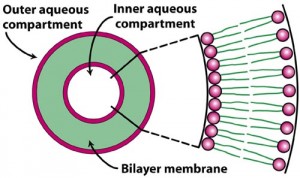 That’s fine, as the phospholipid balls are like small cells and can penetrate easily into the skin. Once in the skin they release their contents. Hooray, what a brilliant discovery!!!! It’s a pity I’m now going to spoil the fun again by giving a couple of critical observations….
Too good to be true?
- Liposomes separate very easily in fat or in the presence of surfactants or emulsifiers (substances that bind oil and water). That is necessary, otherwise they wouldn’t be able to release the active substances in the skin. Put them into a jar of cream and they will separate from each other in the jar. Bye bye!…. Liposomes work best in a gel. In a shampoo or cleanser they definitely won’t survive! (Romanowski. P.; Stability testing of cosmetic products)
- Under certain conditions (eg. in the presence of fatty acids) a liposome can fuse with its brothers and sisters. You can imagine that it is no longer so easy for such an overweight liposome to penetrate into the skin.
- They do not react well to oxygen and heat. The liposomes in your product have been exposed to a lot of harsh conditions before ending up in your bathroom. On top of that add the number of times you have opened the pot and if you take it to Spain or another warm country you know what that means. The end of the liposomes! Furthermore, liposomes generally like it best at around pH 6.5; change this drastically and the liposomes quickly give up….
- Liposomes also contain substances which are not so beneficial for your skin. This, for example, can be certain chemical sunfilters or preservatives. There is an increased chance that these substances will end up in your blood. You’d rather not have that!
- Not all liposomes are the same. There are those without cavities and without active substances. Therefore check the ingredients list to see if there are active substances in your product. You can also imagine that just a couple of liposomes in your product won’t do anything. Check that too. If your product is full of them then you should see ‘lechitin’ at the top.
I am still hopeful that those liposomes can deliver. They are busy experimenting in both the medical and cosmetic world to try and make the particles more stable. I will keep you posted on any new developments!!!
Regards Jetske.
(Dr. Jetske Ultee-Research Physician Cosmetic Dermatology)
You can also read the blogs:
‘What Is a Serum?‘,
‘Caffeine‘,
‘Luxury Ingredients for Your Skin‘,
‘Alcohol in Skincare Products; Rather Not!‘,
‘Ingredient Choice for Pigmentation‘,
‘Argan Oil: The New Wonder Drug’.